WCC Seating Explained
March 6, 2026For many years the World Crokinole Championship (WCC) has used a simple method for rotating players through the preliminary round:
- every player gets a scorecard colour, and a starting table number to play their first game
- After each game the players with one coloured scorecard move up in table numbers, and the players with the other coloured scorecards move down
Given that the WCC preliminary round involves three categories and around 300 players (and the possibility of any of those 300 players being a no-show without warning), it’s probably the only rotation methodology that can be used to get the preliminary round completed without encountering several instances of chaos, confusion, and time wasting.
The long-known downside of the WCC preliminary round is that the rotation methodology results in everyone playing a unique set of opponents, such as in the 2025 competitive singles event where everyone would have played a unique set of 10 out of a possible 127 opponents. This is of course in contrast to many other tournaments where the field is split into groups, and everyone within the same group plays the same set of the opponents. So the WCC methodology is a ripe opportunity for some players to get an advantage/disadvantage by playing a relatively weak/strong set of opponents.
In the WCC events prior to 2024, players randomly drew their table number and colour as they entered the playing area, and it was frequent to see players, like myself, craning their necks to look down the line at who their set of opponents would be. Sometimes I’d see a lot of familiar faces and start to feel poorly about my chances, and sometimes I’d see a bunch of unknown faces and count myself lucky.
Of course, having the qualifiers of the World Championship preliminary round being influenced by random chance of opponents is not ideal.
So when I took over the registrations of the WCC in 2024, it was something I looked to change. And how I did that will be explained now.
Understanding the WCC Rotation
When a tournament separates players into groups and sets up a rotation with either a bye (in the case of an odd number of players in the group), or an anchor (in the case of an even number), it’s easy to see the rotation results in every player facing every opponent for one game.
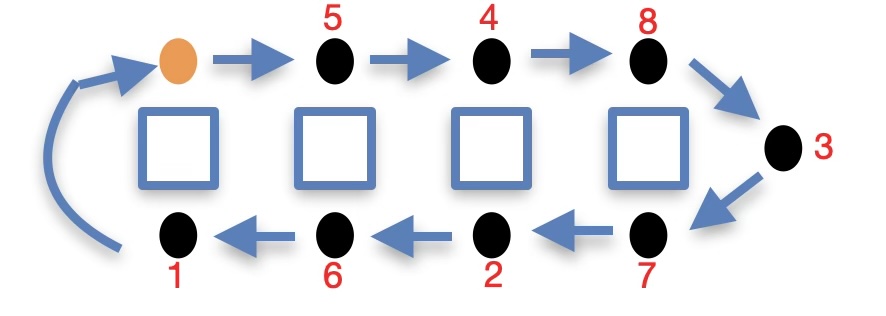
After your first opponent, you play every second player in the line until you’ve completed the entire cycle.
And if you want to make your round robins fair, in the sense that you’d like the each player’s quality of opponents to be the same or very similar, this can be accomplished by ensuring each group has an equal number of strong players in it.
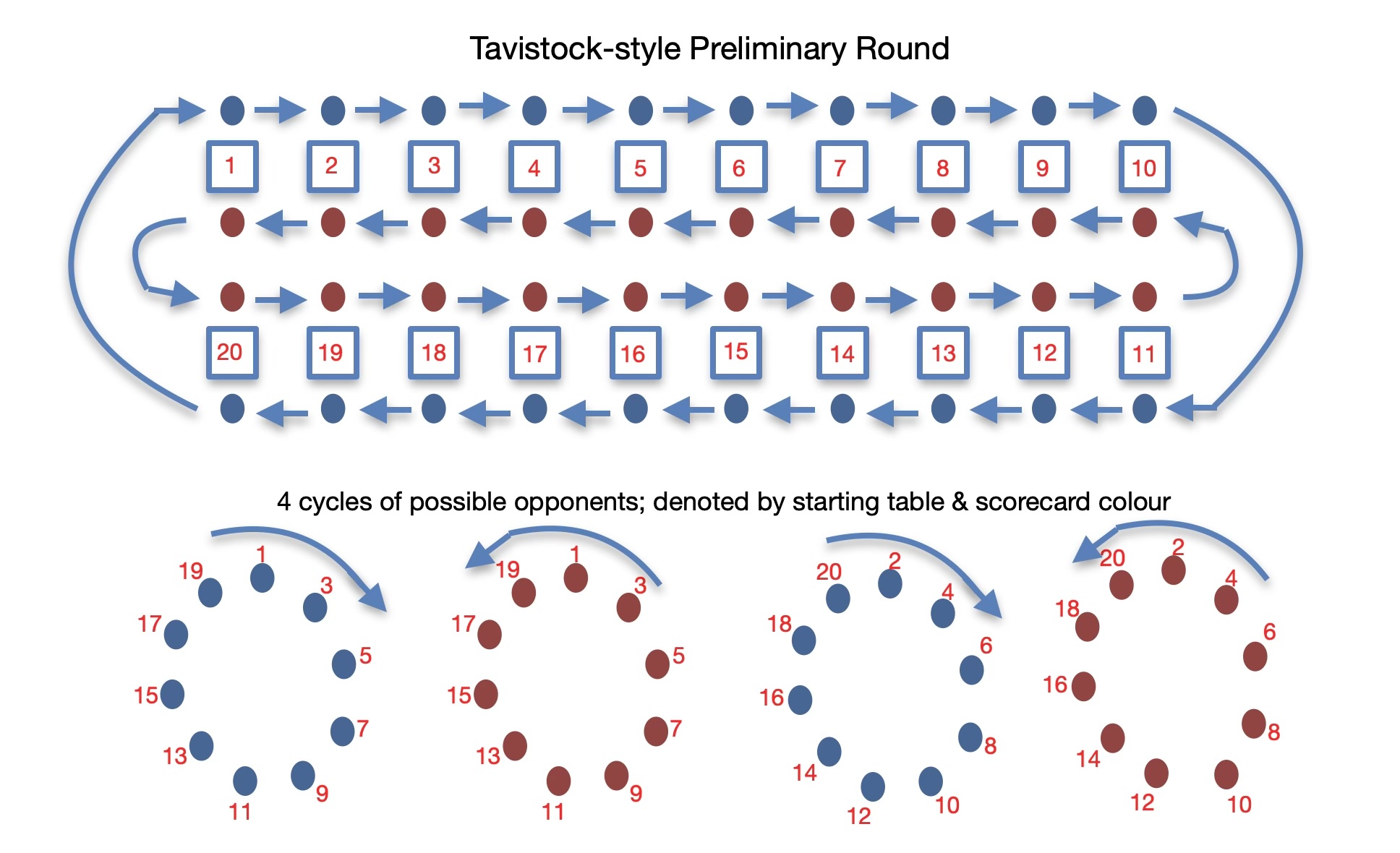
The WCC rotation is more complex to understand. After you draw a scorecard colour (say blue), you’d only play opponents who have a white scorecard, and if your starting table number is an even number you’d only play opponents who had a starting table number that was also even (and vice versa for odd). (The exception to this rule is if there are an odd number of tables in the entire preliminary round, in which case players who loop around from table 1 to the highest numbered table would at some point switch to facing opponents of opposite even/odd number starting points.)
The result is the WCC rotation creates 4 separate cycles of possible opponents, of which everyone plays their own unique slice of 10 opponents (if playing 10 games). (If it’s an odd number of tables then there’s 2 separate cycles of possible opponents.) Which cycle of opponents you play, and where in that cycle your opponents are, depends on your scorecard colour and starting table number.
The image below shows how a 20 table rotation creates these 4 cycles, with each opponent denoted by their starting table number. A player starts by facing an opponent of the opposite scorecard colour and their same starting table number, and then progresses either clockwise or counterclockwise around the cycle until all prescribed games in the round are played.
Now knowing this, the challenge for creating a fair preliminary round with X number of games, requires that each cycle has an equal quality of player strengths, and that each cycle is ordered in such a way that every partition of the cycle into a length of X results in the same quality of player strength.
If that sounds complicated to you, you can be rest assured that it is. Graph theory fundamentals were covered in my mathematics undergrad, but we didn’t address the travelling salesmen problem, let alone this much more difficult challenge of finding a path through a complete graph that visits all nodes but also has edge weights with similar costs when you divide the path into partitions.
But fortunately if you let go of the idea of getting a mathematically perfect solution, something I did after a couple weeks of mulling this over, you can come up with a pretty good solution that doesn’t involve doctorate-level mathematics.
How the Seats Were Assigned
Last year the approach was to divide all players (or teams, in the case of doubles) into 5 groups: Tier 1, Tier 2, Tier 3, Tier 4, and finally, unseeded. Tier 1 would compose of the best players entered into the competition, while Tier 2 would be the next set of top players, followed by Tier 3 and Tier 4. The unseeded group would represent those without a pedigree among the players in Tiers 1 to 4, or those for who no tournament performance was known.
Having tiered the players, they were then distributed into cycles and ordered so that players of different tiers were distributed sequentially. It was completely random where players within a particular Tier would reside, so long as they were in a spot that should be held by their Tier.
In doubles the cycles were constructed with unseeded teams in every second position, and tiered teams then filling in those gaps in the order of Tier 4, Tier 3, Tier 2, and then Tier 1. In singles the cycles were constructed with two unseeded players followed by a tiered player throughout the cycle, with those tiered players ordered 4, 3, 2, and 1, as in the doubles case.
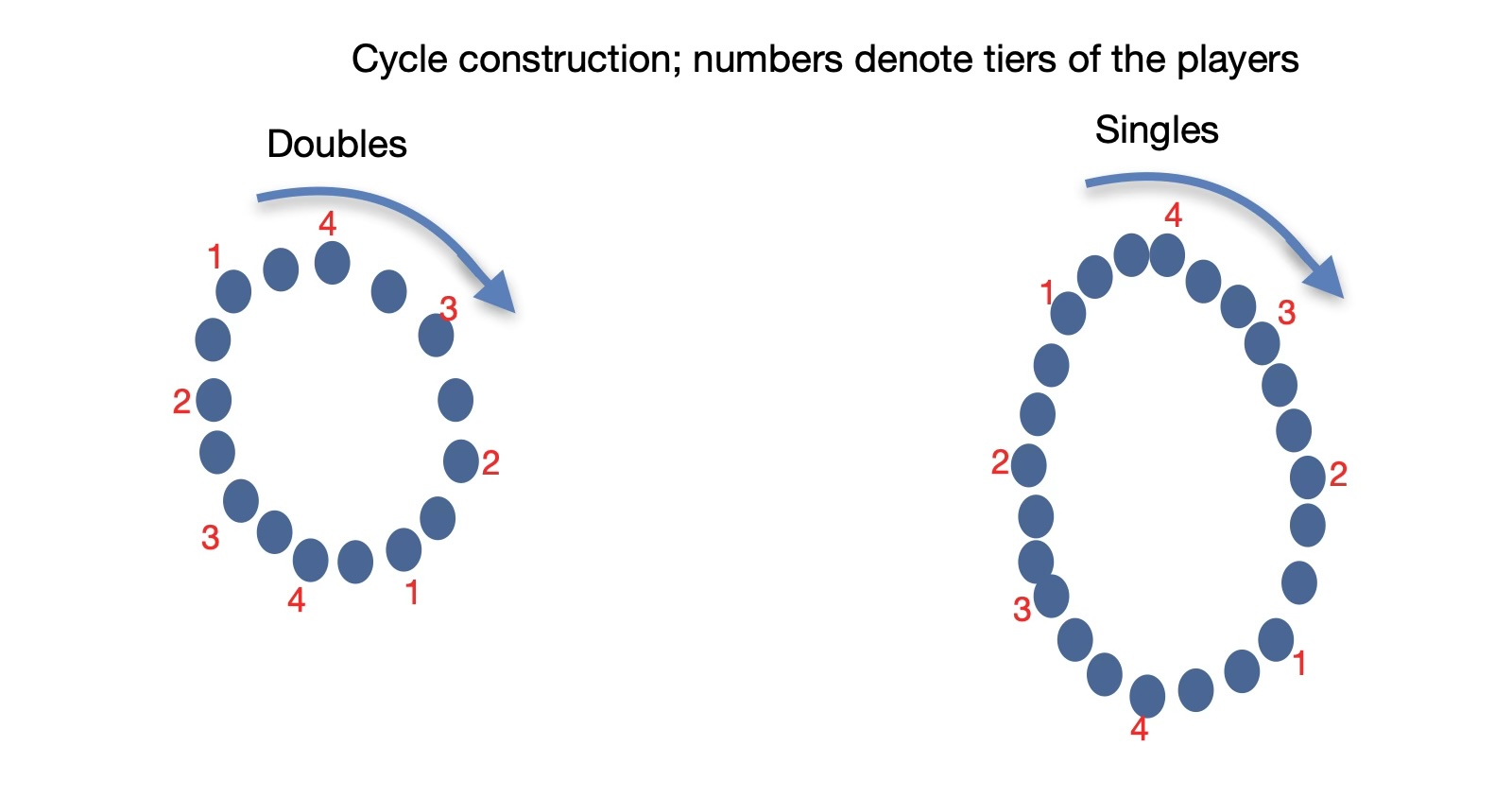
The result in the doubles case is that every team, regardless of starting position, plays one team in each of Tier 1, 2, 3 and 4, as well as four unseeded teams (since they play 8 games). For singles, every player played three or four tiered players, of which those were all players of different tiers (as they play 10 games in singles).
So long as you establish the tiers in a good way, this approach is effective in balancing the preliminary round for all players.
For simplicity sake, in 2026 the singles seating will be modified to include 5 Tiers with the Tiered players seated every second seat such that everyone should play precisely 5 tiered players in their 10-game round robin.
Uncertain numbers
There’s a challenge to running every crokinole tournament, which is you can’t be certain everyone will actually show up to make the number of competitors exactly as expected. This is an even greater challenge with the World Championships because the number of people attending is so much larger.
It’s common that up to 5 people registered for a category do not attend, and we only learn this information at the moment when we are about to play, which is much too late to be changing seating assignments. When there’s missing players the WCC opts to remove players from the highest numbered tables and send them to fill in places at lowered numbered tables.
If a tiered player is one of the ones missing there’s little we can do. It would be too cumbersome to identify another player in the field of a lower tier and move them up to a higher tier, and then replace their vacant spot in the tier they just left. Instead we accept this bit of randomness and players who would have played a tiered player who are now playing an unseeded player can be regarded as slightly fortunate.
However we do make one change to prevent the possibility of a player for Tier 1 or 2 being displaced from their high numbered tabled and bumped down randomly to some lower table. Such a scenario would be unfortunate for their opposition who might now face multiple opponents in the 1st or 2nd Tiers in their preliminary round. The change we make is that if the size of the cycles are working out that a Tier 1 or 2 slot will be situated in the highest 3 numbered tables, we replace that position with a Tier 4 player. Then if that Tier 4 player is sent to a lower numbered table, the change to the opposition strength of the players they will face isn’t greatly impacted.
How Tiers are Assigned
How the Tiers are assigned is a topic that is re-analyzed each year, and has not been set yet for 2026. The World Championship prefers to place a good deal of weight on results for its own event in the last two years, and generally prefers to consider one elite performance at one event in the past year higher than consistent strong results throughout the year.
In 2025 the WCC ranked players for singles as follows:
- Top 4 from 2024 WCC
- NCA Tier 1 singles winners in past 12 months
- NCA Tier 1 singles 2nd place finishers in past 12 months
- Top 10 finishers at NCA Tour
- 5th-10th at 2024 WCC
- NCA Tier 1 singles 3rd and 4th place finishers in past 12 months
- Top 10 finishers at 2023 WCC
- NCA Tier 2 singles winners in past 12 months
- . . .
And the ranking went on further and further, along with a couple of wildcard positions given to known international attendees of stature.
While people could reasonably argue that certain criteria should be considered more or less impressive, the main objective of the WCC approach is to eliminate the possibility of a particularly unfavourable arrangement of opponents being assigned, and this accomplishes that well.